http://www.mindbodygreen.com/0-91/The-7-Chakras-for-Beginners.html
The 7 Chakras for Beginners
BY MINDBODYGREEN
OCTOBER 28, 2009 12:00 AM EDT
OCTOBER 28, 2009 12:00 AM EDT
 The 7 Chakras are the energy centers in our body in which energy flows through.
Blocked energy in our 7 Chakras can often lead to illness so it's important to understand what each Chakra represents and what we can do to keep this energy flowing freely. Here's our quick summary:
1. Root Chakra - Represents our foundation and feeling of being grounded.
- Location: Base of spine in tailbone area.
- Emotional issues: Survival issues such as financial independence, money, and food.
- More on Root Chakra healing
2. Sacral Chakra - Our connection and ability to accept others and new experiences.
- Location: Lower abdomen, about 2 inches below the navel and 2 inches in.
- Emotional issues: Sense of abundance, well-being, pleasure, sexuality.
- More on Sacral Chakra healing
3. Solar Plexus Chakra - Our ability to be confident and in-control of our lives.
- Location: Upper abdomen in the stomach area.
- Emotional issues: Self-worth, self-confidence, self-esteem.
- More on Solar Plexus Chakra healing
4. Heart Chakra - Our ability to love.
- Location: Center of chest just above heart.
- Emotional issues: Love, joy, inner peace.
- More on Heart Chakra healing
5. Throat Chakra - Our ability to communicate.
- Location: Throat.
- Emotional issues: Communication, self-expression of feelings, the truth.
- More on Throat Chakra healing
6. Third Eye Chakra - Our ability to focus on and see the big picture.
- Location: Forehead between the eyes. (Also called the Brow Chakra)
- Emotional issues: Intuition, imagination, wisdom, ability to think and make decisions.
- More on Third Eye Chakra healing
7. Crown Chakra - The highest Chakra represents our ability to be fully connected spiritually.
- Location: The very top of the head.
- Emotional issues: Inner and outer beauty, our connection to spirituality, pure bliss.
- More on Crown Chakra healing
..........................................
http://ways-to-harmony.ucoz.ru/index/chakras/0-11
Chakras
Chakras are the subtle but powerful energy centers inside the human body.
In our time of change the present seven(7) chakras cannot handle fifth-dimensional frequencies due to restrictions and must be opened up. As lightbody activation progresses, those seven chakras open up, along with seven chakras outside the body plus the Alpha and Omega chakras.
In our time of change the present seven(7) chakras cannot handle fifth-dimensional frequencies due to restrictions and must be opened up. As lightbody activation progresses, those seven chakras open up, along with seven chakras outside the body plus the Alpha and Omega chakras.
You can read more In section Advanced Chakra System http://ways-to-harmony.ucoz.ru/index/advanced_chakra_system/0-60
When we choose to work with Light energies and evolve spiritually, our higher chakras open naturally; however, we can assist this process through active spiritual practices. The Unified Chakra meditation that was given to us to help this process along. The Chakra Unification meditation harmonizes all of the chakras from the Soulstar above the head to the Earthstar below the feet and harmonizes all the energies of the lightbody with the physical body, providing us with a deeper connection to our spiritual essence.
The Unified Chakra meditation http://ways-to-harmony.ucoz.ru/index/the_unified_chakra/0-62
The Unified Chakra meditation http://ways-to-harmony.ucoz.ru/index/the_unified_chakra/0-62
This 7-chakra system governs your development on the Earth, helping you to align with the planet and learn your earthly lessons.There are seven(7) main energy centres (chakras) of the body which resonate with the seven rainbow colours. A Chakra is like a spiral of energy, each one relating to the others. Each chakra works with a group of vital organs. Together, they ensure the wellness of a person. However, these chakras can be prone to deficiencies and imbalances. This is where Reiki can help.

Crown Chakra (7)-Sahasrara
The Colour Violet/Purple relates to the CROWN chakra which is at the top of the head in the human body.
The related organ to the crown chakra is the brain.
The endocrine gland is the pineal gland.
The Colour Violet/Purple relates to the CROWN chakra which is at the top of the head in the human body.
The related organ to the crown chakra is the brain.
The endocrine gland is the pineal gland.
The crown chakra corresponds to the person's whole being. It is one's direct connection to the spirit. It can lead the way on the path towards universal existence. It is also through this chakra that one can experience inner peace. It opens the path towards spiritual wisdom and can enhance one's psychic abilities.
Problems associated with the Crown Chakra
Some of the physical problems are: Depression, Parkinson's disease, Schizophrenia, Epilepsy, Senile dementia, Alzheimer's, Many mental disorders, Confusion, Dizziness, and even just feeling as if one has a muzzy head.
Some of the physical problems are: Depression, Parkinson's disease, Schizophrenia, Epilepsy, Senile dementia, Alzheimer's, Many mental disorders, Confusion, Dizziness, and even just feeling as if one has a muzzy head.
Psycho-spiritual
Violet relates to self knowledge/ spiritual awareness.
The colour violet is the union with your higher self, with spirituality, and your higher consciousness.
Violet relates to self knowledge/ spiritual awareness.
The colour violet is the union with your higher self, with spirituality, and your higher consciousness.
Third-eye Chakra(6) -Ajna
The third-eye chakra has indigo colour and corresponds to the brain, nose, face, eyes, and almost all of the organs situated in the head.Indigo relates to self responsibility. It also has power over the lower brain, pituitary gland, and the central nervous system. This is the chakra that opens one's intuition. It allows a person to visualize, manifest, and even create visions beyond ordinary sight.
The ability to see things from a 'higher' viewpoint rather than purely for satisfaction of the ego or one's material comfort. Intuitive messages are unique to you and are for your own personal growth and differ from the gut feelings.
The ability to see things from a 'higher' viewpoint rather than purely for satisfaction of the ego or one's material comfort. Intuitive messages are unique to you and are for your own personal growth and differ from the gut feelings.
Problems associated with the Third-eye Chakra
Some of the physical problems are:- Tension headache, Migraine, Visual defects, Short-sightedness, Long-sightedness, Glaucoma, Cataracts, Catarrh, Sinus problems, Some ear problems.
Some of the physical problems are:- Tension headache, Migraine, Visual defects, Short-sightedness, Long-sightedness, Glaucoma, Cataracts, Catarrh, Sinus problems, Some ear problems.
Throat Chakra (5)-Vishuddha
The throat chakra has blue colour and controls the thyroid gland, throat, jaw, upper lungs, and vocal chords. It may also affect the digestive system. Blue relates to self expression.This chakra governs a person's ability to communicate. It also inspires mental creativity.
Problems associated with the Throat Chakra
Some of the physical problems are:- Thyroid problems - over active/ under-active, Anorexia nervosa - this is a multi-chakra problem, but has a strong connection to the throat chakra, Asthma, Bronchitis, Hearing problems, Tinnitus (tinnitus may also be connected to problems with the brow chakra), Problems of the upper digestive tract, Mouth ulcers, Sore throats, Tonsillitis.
Heart Chakra (4)-Anahata
As its name implies, this chakra is positioned right on the heart and has pink or green colour. It controls many of the functions associated with the heart, including the arms, lower lungs, skin, and the thymus gland. This is the chakra of the entire circulatory system.
This chakra relates to love / self love. The ability to give and take unconditionally.
When balanced we are able to give this love and also to love and nurture ourselves, warts and all.The Heart Chakra is the one that creates the link from the physical world towards spiritual existence.
As its name implies, this chakra is positioned right on the heart and has pink or green colour. It controls many of the functions associated with the heart, including the arms, lower lungs, skin, and the thymus gland. This is the chakra of the entire circulatory system.
This chakra relates to love / self love. The ability to give and take unconditionally.
When balanced we are able to give this love and also to love and nurture ourselves, warts and all.The Heart Chakra is the one that creates the link from the physical world towards spiritual existence.
Problems associated with the Heart Chakra
Some physical problems relating to the heart chakra are:- Heart diseases, Diseases of the Immune System for example, Aids and ME (myalgia encephalomyelitis, sometimes referred to as chronic fatigue syndrome or post viral syndrome), Other problems related to the immune system, allergies and cancer of the breast.
Some physical problems relating to the heart chakra are:- Heart diseases, Diseases of the Immune System for example, Aids and ME (myalgia encephalomyelitis, sometimes referred to as chronic fatigue syndrome or post viral syndrome), Other problems related to the immune system, allergies and cancer of the breast.
Solar Plexus Chakra (3)-Manipura
This chakra has yellow colour and directly affects the liver, stomach, gall bladder, small intestines, and pancreas. It is associated with a person's intellectual processes. The Solar Plexus Chakra is also the seat of power. Once open and balanced, it can transform all of your aspirations and hopes into reality.
Yellow relates to self worth. How we feel about ourselves and how we feel others perceive us. This is the area of the personality, the ego and the intellect.
Yellow relates to self worth. How we feel about ourselves and how we feel others perceive us. This is the area of the personality, the ego and the intellect.
Problems associated with the Solar Plexus ChakraSome of the physical problems relating to the solar plexus chakra are:- Diabetes, Pancreatitis, Liver disease, Peptic ulcer, Coeliac's disease, Gall stones.
Sacral Chakra (2)-Svadhisthana
The Sacral Chakra is positioned on the navel and has orange colour. The whole reproductive system belongs to it, including the bladder and spleen. This chakra can fuel one's creativity, emotions, and sexuality.
Orange relates to self respect. Having the ability to give ourselves the freedom to be ourselves, to have and respect our own boundaries and therefore, be able to respect those of others. Orange relates to our ability to "give and take" within our relationships with others.
Orange relates to self respect. Having the ability to give ourselves the freedom to be ourselves, to have and respect our own boundaries and therefore, be able to respect those of others. Orange relates to our ability to "give and take" within our relationships with others.
Problems associated with the Sacral Chakra
Some of the associated problems relating to the sacral chakra are:- Pre-menstrual syndrome, Problems with menstrual flow, Uterine fibroids, Ovarian cysts, Irritable bowel syndrome, Endometriosis, Testicular disease, Prostatic disease, Low back pain.
Base Chakra or Root Chakra (1)-Muladhara
The base chakra is positioned at the bottom of the pelvis and has red colour The organs that are under it are the kidneys, adrenal glands, leg bones, large intestines, rectum, and spinal column. This chakra relates to self awareness. It is the area of survival and stability and your place on this earth and security issues and keeps a person grounded to his physical existence.
Problems associated with the Base Chakra
Some of the associated problems relating to the base chakra are:- Constipation, Diarrhoea, Piles, Colitis, Crohn's disease Cold fingers and toes, Frequency of urination, Hypertension (high blood pressure), Kidney stones, Impotence, Problems with hips, legs and feet.


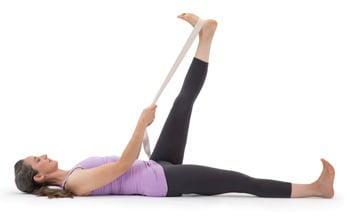 Now that you have a picture of the psoas in your mind, let’s see if you can feel it contracting. When the psoas contracts, it will pull the femur and the spine closer together (hip flexion). If you are lying on your back, contracting the right psoas will help lift your right leg off the floor as in supta padangusthasana, or reclining big toe pose. If the back of your leg is flexible, you may be able to bring it toward your torso past perpendicular, but the psoas stops contracting at about 90 degrees, when the leg is vertical. At that point, gravity is no longer pulling the leg back toward the floor, so the hip flexors can relax. On the other hand, if the back of your leg is tight and you can’t bring your leg to the 90-degree point, the psoas contracts the entire time you hold your leg up, even if you have a strap wrapped around your foot. By definition, this is an isometric contraction: the muscle is working, but not changing length. Anytime you’re holding a body part against the pull of gravity, it’s an isometric contraction.
 Navasana is another yoga pose that strengthens the psoas isometrically. You can feel the basic action of the psoas in navasana while sitting on a chair. Sit tall on the front edge of the chair, with your arms stretched out in front of you, parallel to the floor. Then lean toward the back of the chair without touching it, while keeping your chest lifted. As soon as your body inclines backward past vertical, gravity is trying to pull your torso down toward the earth, and the psoas contracts to hold you cantilevered.
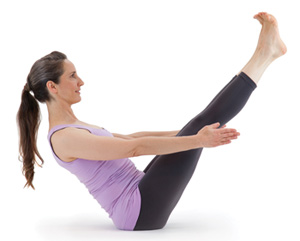 If you’d like to move into the full pose, tip your torso back a little farther, lift your feet off the floor, and find your balance. Even with your knees still bent, the psoas has to work harder, as it’s now holding up the weight of your torso plus the weight of your legs against gravity’s pull. You can stay here for several breaths, or go ahead and challenge the muscle even more by straightening your knees. In the full expression of navasana, the psoas acts like a guy-wire between your spine and the thighs to hold the beautiful V shape of the pose. This is a challenging pose, working not only the psoas, but also the abdominals, the back muscles, and the quadriceps; if you are a beginner, try working regularly on the preparatory steps to gradually build strength for the full variation.
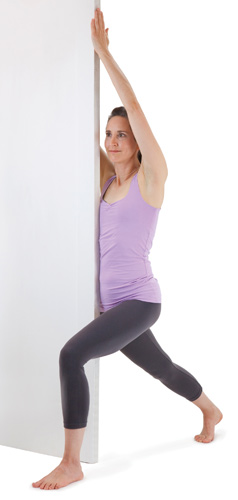 A good way to isolate the psoas stretch, whether you’re a beginner or an experienced practitioner, is to practice virabhadrasana I in a doorway. Find an open doorway (or a pillar) and step up close so that the right side of your body is just behind the door jamb. Step your left leg through the doorway, and place your right foot two to three feet behind you, with that back heel off the floor. Stretch your arms overhead and rest your hands on the wall. Bend both knees slightly, and align your pubic bones, navel, and breastbone with the door frame.
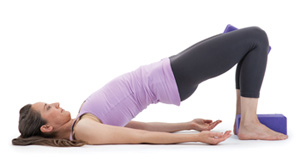 Now that you’ve stretched your psoas, you’re ready to work on backbending poses, which require full extension in both hips. In setu bandha sarvangasana, for instance, tight and short psoas muscles will tilt the pelvis anteriorly as you lift your pelvis off the floor, causing sharp compression in the lower lumbar vertebrae. So it’s important to prepare your body for backbending by first stretching the hip flexors, especially if you lead a sedentary lifestyle.


